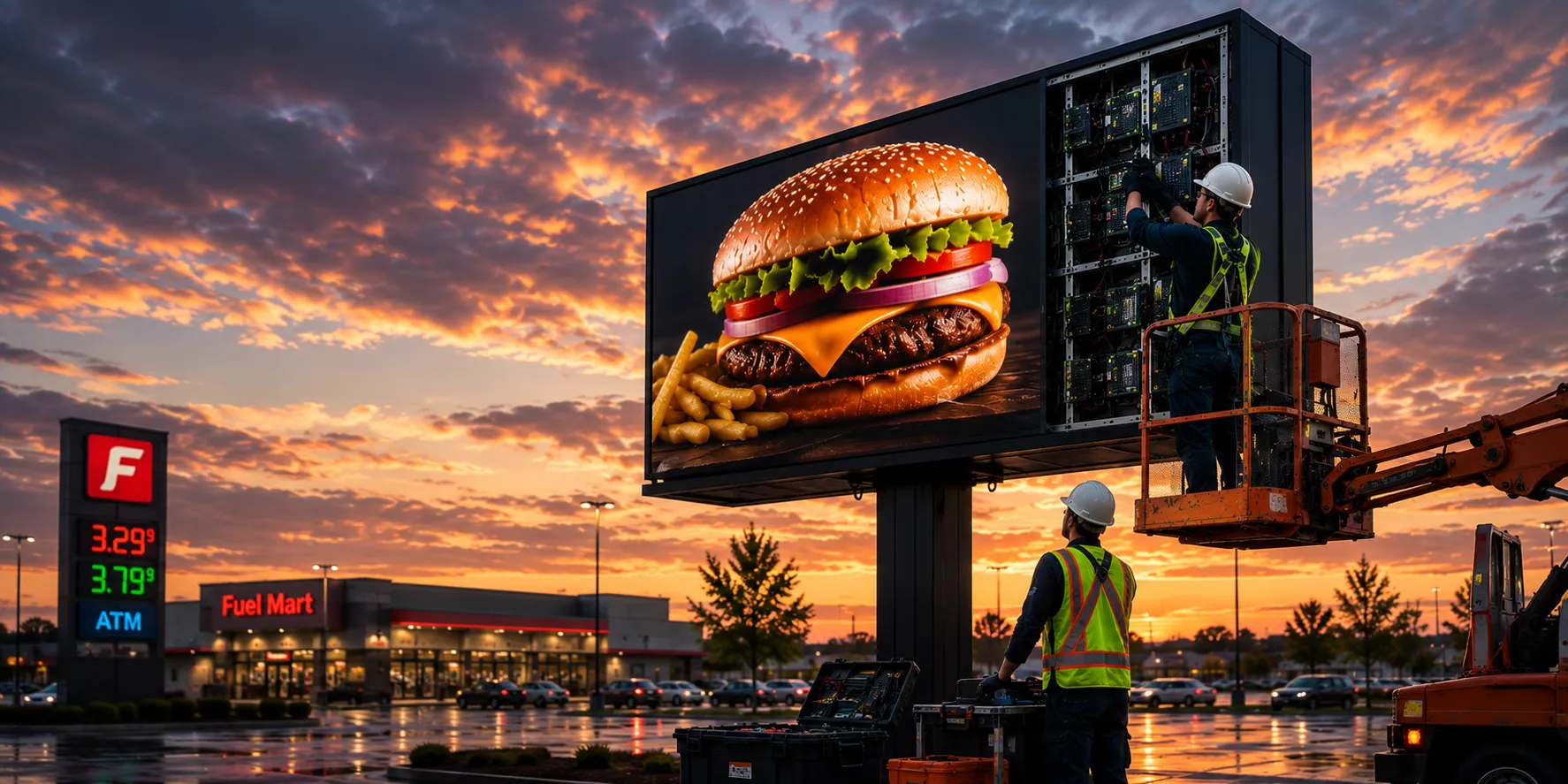
Getting an LED display to perform successfully requires more than selecting the right screen. The site, structure, electrical system, connectivity, installation, serviceability, and long-term maintenance all contribute to the performance and economics of the finished system.
A successful project considers the entire lifecycle before the equipment is ordered—not after it arrives.
RELATED RESOURCES
Commercial Display Investment Guide
Understand the broader investment decision..
ROI Calculator
Model the potential economics of a display investment.
Marketing Asset Assessment
Evaluate how the technology could fit your location and marketing assets.
RELATED TECHNOLOGY
Choosing the Right Display
Start with the application before evaluating specifications.
Power, Energy & Operating Costs
Understand how ambient light affects display performance.
Control Systems & Content Managment
Understand how content and scheduling affect display operation.
READY TO APPLY WHAT YOU’VE LEARNED?
Get a Free Site Analysis
The Display Is Part of a Larger System
An LED display may be the most visible component of the project, but it isn’t the only one.
A typical installation can involve:
- Display hardware
- Structural support
- Foundations or mounting systems
- Electrical service
- Conduit and wiring
- Data connectivity
- Control equipment
- Content management
- Installation labor
- Permitting
- Service access
- Ongoing maintenance
The display has to work within that larger system.
The objective isn’t simply to install a screen. It’s to create a functioning, reliable marketing asset.
Start With the Site
Before selecting equipment, the proposed location should be evaluated.
Important considerations include:
Visibility
Can the intended audience actually see the display?
Viewing Distance
How far away will the audience normally be?
Viewing Angle
From which directions will the audience approach?
Environment
What weather and lighting conditions will the display encounter?
Structure
What will support the display?
Electrical
Where will the required power come from?
Connectivity
How will content reach the display?
Access
How will technicians safely reach the equipment?
A good site evaluation identifies these issues before they become installation problems.
Structural Requirements
Larger outdoor displays can create significant structural requirements.
Depending on the application, the project may involve:
- Steel support structures
- Poles
- Foundations
- Concrete work
- Wind-load considerations
- Engineering
- Mounting hardware
- Access equipment
The structure needs to support the display while accounting for environmental conditions throughout its expected life.
The display and its support system should therefore be treated as one engineered installation.
Electrical Infrastructure
LED displays require reliable electrical power.
The installation may need to address:
- Available electrical capacity
- Voltage
- Circuit requirements
- Disconnects
- Conduit
- Wiring
- Distribution
- Grounding
- Electrical code requirements
The distance between the electrical service and display location can also affect installation cost.
A site that appears ideal from a marketing perspective may require substantial infrastructure before the display can operate.
Connectivity
A digital display also needs a way to receive content.
Depending on the application, connectivity may involve:
- Ethernet
- Wi-Fi
- Cellular
- Local network infrastructure
- Other communications systems
The appropriate solution depends on the location and operating model.
A single display at a local business may have simple connectivity requirements.
A network of displays across multiple locations may require a much more deliberate communications architecture.
Permitting & Approvals
Depending on the location and type of installation, permits or approvals may be required.
These can potentially involve:
- Building permits
- Electrical permits
- Sign regulations
- Zoning requirements
- Structural approvals
- Property-owner approvals
- Local jurisdiction requirements
The specific requirements vary considerably by location.
This is another reason to evaluate the site and regulatory environment before committing to a particular display configuration.
Installation Is More Than Mounting the Display
A professional installation brings together multiple disciplines.
The process may involve:
Site preparation
↓
Structural installation
↓
Electrical infrastructure
↓
Display assembly
↓
Control system installation
↓
Network connectivity
↓
Configuration
↓
Content deployment
↓
Testing
↓
Training & handoff
The final step is particularly important.
The display isn’t finished simply because it turns on.
It needs to be configured and tested as a complete operating system.
Serviceability Should Be Designed In
Every commercial technology asset eventually requires some level of service.
Components may need to be:
- Inspected
- Cleaned
- Adjusted
- Replaced
- Reconfigured
- Repaired
The ease with which those tasks can be performed affects long-term operating cost.
Questions worth asking include:
How are modules replaced?
Can components be accessed safely?
How quickly can a failed component be identified?
Is specialized equipment required?
Can the display remain partially operational during service?
Serviceability is part of the original design—not something to figure out after a failure.
Maintenance Is Part of Ownership
Outdoor LED displays operate continuously in environments that can be demanding.
Routine maintenance may include:
- Visual inspection
- Cleaning
- Structural inspection
- Electrical inspection
- Module replacement
- Power-supply replacement
- Cable inspection
- Software updates
- System monitoring
The appropriate maintenance program depends on the display and environment.
A display in a controlled indoor environment may require relatively little physical maintenance.
A large outdoor display may require considerably more attention.
Plan for the Lifecycle
The initial installation is only the beginning of the ownership period.
A better investment analysis considers:
Acquisition
What does the equipment cost?
Installation
What does it take to deploy?
Infrastructure
What does the site need?
Operation
What does it cost to run?
Maintenance
What does it cost to keep operating?
Content
What does it cost to keep the asset productive?
Replacement
What components may eventually need to be replaced?
Useful Life
How long can the system reasonably remain productive?
This is the lifecycle perspective.
Total Cost of Ownership
The purchase price is therefore only one component of the investment.
A simplified model looks like:
Equipment
Installation
Infrastructure
Energy
Maintenance
Content & Management
Financing
=
Total Cost of Ownership
That number is much more useful than the equipment price by itself.
But even total cost of ownership isn’t the ultimate measure.
The real question is:
What value does the asset produce over that lifecycle?
Lifecycle Value Is More Important Than Lifecycle Cost
This is where the Technology Guide connects back to the larger Envoltage philosophy.
A display isn’t purchased simply to own a display.
It is purchased because the owner expects it to accomplish something.
That might be:
- Increased sales
- More customer visits
- Better promotions
- Improved communication
- Brand awareness
- Advertising revenue
- Vendor-funded marketing
- New revenue streams
The investment should therefore be evaluated against the value it can create.
Cost tells you what the asset requires.
Return tells you whether the asset was worth owning.
Reliability Has Economic Value
Reliability isn’t simply a technical characteristic.
If a display is unavailable, the marketing opportunity may disappear with it.
For an owner using the display to promote its own business, downtime can mean missed promotional opportunities.
For an operator selling advertising time, downtime can mean lost inventory and dissatisfied advertisers.
That makes:
- Component quality
- Serviceability
- Monitoring
- Maintenance
- Support
economic considerations—not merely technical ones.
Design for the Future
Technology and marketing requirements can change over time.
A well-planned installation should consider future needs where practical.
For example:
- Can the control system support additional functionality?
- Can the network accommodate additional displays?
- Is service access adequate?
- Can components be replaced without rebuilding the entire installation?
- Is there flexibility to change content strategies?
- Can the system scale if the application succeeds?
The objective isn’t to predict the future perfectly.
It’s to avoid unnecessarily locking the investment into today’s assumptions.
The Envoltage Approach
This is where we deliberately move beyond the traditional equipment-sales model.
We don’t view installation as:
“Get the display mounted and turn it on.”
We view it as:
“Build an operating system around the business objective.”
That means considering the entire path:
Business Objective
↓
Audience
↓
Site
↓
Display
↓
Infrastructure
↓
Installation
↓
Content
↓
Operation
↓
Maintenance
↓
Measurement
↓
Business Result
The display is one component within that process.
Before You Buy
Before committing to an LED display project, make sure you can answer:
What is the display supposed to accomplish?
Who is the audience?
Where will they see it?
What does the site require?
What infrastructure is available?
What will installation cost?
How will the system be managed?
What will it cost to operate?
How will it be maintained?
How long should it remain productive?
How will success be measured?
If those questions have good answers, the equipment decision becomes much easier.
The Bottom Line
A successful LED display project is designed around the entire lifecycle—not just the purchase of the display.
The equipment, site, infrastructure, installation, content, maintenance, and operating strategy all contribute to the outcome.
And ultimately, the most important question isn’t:
“How much does the display cost?”
It’s:
“What will it take to make this asset perform—and what can it produce in return?”
Plan the entire system. Then buy the display.
Convert Attention Into Results
Request Your Free Marketing Asset Assessment →