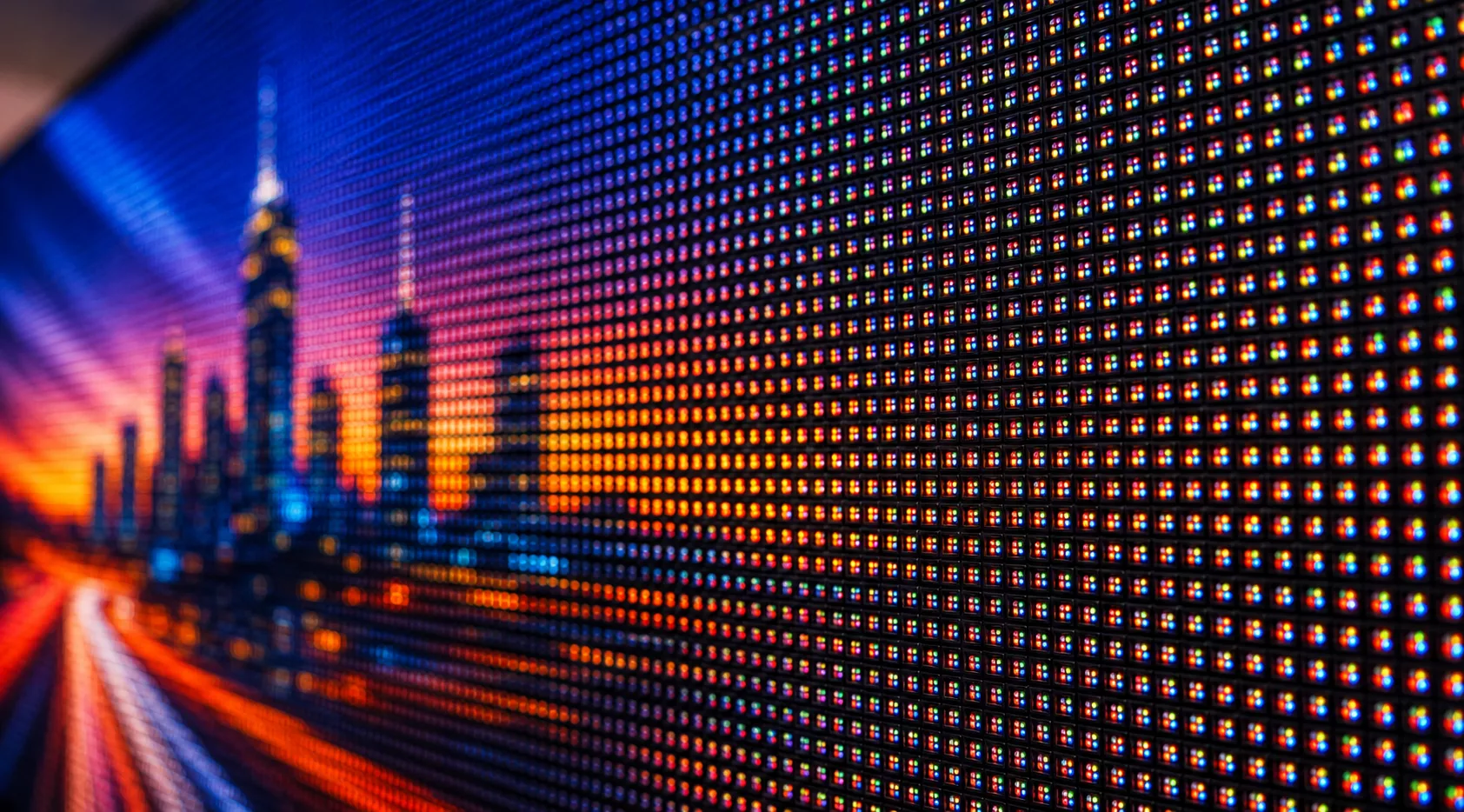
LED displays are built from thousands—or millions—of individual light-emitting components assembled into modules and cabinets. The way those components are packaged, protected, connected, and constructed can influence image quality, durability, serviceability, and lifecycle performance.
Understanding the construction of a display helps explain why two displays with similar specifications can produce very different long-term results.
RELATED RESOURCES
Commercial Display Investment Guide
Understand the broader investment decision..
ROI Calculator
Model the potential economics of a display investment.
Marketing Asset Assessment
Evaluate how the technology could fit your location and marketing assets.
RELATED TECHNOLOGY
Choosing the Right Display
Start with the application before evaluating specifications.
Pixel Pitch & Viewing Distance
Understand how pixel density relates to audience distance.
Brightness & Visibility
Understand how ambient light affects display performance.
Indoor vs Outdoor
Understand how the operating environment changes display requirements.
Weather Protection & Durability
Understand the environmental requirements of outdoor displays.
Video Performance
Understand the performance requirements of dynamic content.
An LED Display Is a System of Components
A large LED display may look like a single screen, but it is actually an integrated system made up of many components.
These can include:
- LED packages
- LED modules
- Pixel circuits
- Driver ICs
- Power supplies
- Receiving cards
- Control systems
- Cabinet structures
- Data connections
- Power distribution
- Thermal-management components
The performance of the finished display depends on how those components work together.
The LED is only one part of the system.
What Is an LED Package?
The LED package is the physical component that contains and protects the LED semiconductor and provides the connections required to operate it.
In an LED display, thousands of these packages work together to create individual pixels.
Different packaging technologies can affect:
- Brightness
- Contrast
- Color consistency
- Viewing angle
- Durability
- Physical protection
- Heat management
- Manufacturing cost
This is why terms such as SMD, COB, and GOB appear frequently in LED display specifications.
SMD LED Packaging
SMD, or Surface-Mount Device, is one of the most widely used LED packaging approaches.
The LED components are mounted directly onto the circuit board.
SMD technology is commonly used across a wide range of indoor and outdoor LED displays because it offers a combination of:
- High brightness
- Good color performance
- Broad viewing angles
- Flexible pixel-pitch options
- Mature manufacturing processes
- Serviceable module construction
For many commercial applications, SMD provides an effective balance of performance and cost.
COB LED Packaging
COB, or Chip-on-Board, takes a different approach.
Instead of packaging each LED chip in an individual traditional package, multiple LED chips are mounted directly onto the circuit board and encapsulated as part of the module.
COB can provide advantages in applications where:
- Very fine pixel pitch is required
- Close viewing distances are important
- Physical protection is a priority
- A highly uniform surface is desired
COB technology is particularly relevant to fine-pitch indoor applications.
But again, the question isn’t whether COB is “better.”
It’s whether its characteristics provide meaningful value for the application.
GOB Protection
GOB, or Glue-on-Board, is a protective process in which the LED surface is coated with a transparent protective material.
This can help protect LED components from:
- Physical impact
- Dust
- Moisture
- Accidental contact
- Environmental contamination
GOB can be particularly useful in applications where the display may experience greater physical exposure.
The important distinction is that GOB is primarily a protection process, while SMD and COB describe different approaches to LED packaging and assembly.
Packaging Affects Durability
The front surface of an LED display is exposed to the environment in which it operates.
Indoor applications may have relatively controlled conditions.
Outdoor applications may encounter:
- Rain
- Dust
- Wind
- Humidity
- Temperature changes
- Physical contact
The way the LED components and modules are constructed can therefore influence how well the display tolerates those conditions.
But packaging is only one part of durability.
Cabinet construction, sealing, electrical design, thermal management, installation, and maintenance all matter too.
Packaging Affects Image Quality
The physical construction of the LED components can also influence the visual characteristics of the display.
Important considerations include:
- Color consistency
- Pixel uniformity
- Brightness consistency
- Contrast
- Viewing angle
- Surface appearance
For close-viewing applications, small differences in construction can become more noticeable.
For distant-viewing applications, other factors may be more important.
Once again:
The audience determines which characteristics matter most.
Construction and Pixel Pitch
Packaging technology also interacts with pixel pitch.
As pixel pitch becomes smaller, the components have to be packed more closely together.
This places greater demands on:
- Manufacturing precision
- Component placement
- Circuit-board design
- Thermal management
- Assembly
- Quality control
Fine-pitch displays therefore require different construction considerations than large-pitch outdoor displays.
This is another reason why the “best” construction technology depends on the application.
Cabinet Construction Matters
The LED modules are only mounted within a larger cabinet structure.
Cabinet design affects:
- Structural strength
- Weight
- Weather protection
- Heat management
- Installation
- Service access
- Alignment
- Module replacement
For large outdoor displays, cabinet construction can become particularly important because the display must withstand environmental exposure while maintaining precise alignment.
For indoor displays, lightweight cabinet designs may provide significant installation advantages.
Thermal Management
Every LED display generates heat.
How that heat is managed can affect long-term reliability.
The design may incorporate:
- Heat-dissipating materials
- Ventilation
- Fans
- Thermal pathways
- Temperature monitoring
- Component placement
As displays become brighter and more densely populated, thermal considerations can become increasingly important.
A well-designed display isn’t simply bright.
It is designed to manage the heat generated while producing that brightness.
Power Supplies and Electronics
Behind the LED surface is another layer of technology.
Power supplies convert and distribute electrical power to the display components.
Driver ICs control the LED pixels.
Receiving cards and control electronics distribute the image signal.
These components can influence:
- Image stability
- Brightness control
- Refresh performance
- Reliability
- Serviceability
This is why evaluating an LED display solely by its LED package type can be just as misleading as evaluating it solely by pixel pitch.
The entire system matters.
Construction and Serviceability
Commercial displays eventually require service.
Modules, power supplies, receiving cards, and other components may need to be replaced during the life of the system.
Good construction can make those tasks easier.
Consider:
- How modules are removed
- How power supplies are accessed
- How data connections are organized
- Whether components are standardized
- Whether individual sections can be replaced
- Whether service can be performed from the front or rear
Serviceability can have a meaningful effect on the total cost of ownership.
Don’t Choose Technology by Acronym
SMD.
COB.
GOB.
These terms can make a display specification sound highly technical, but the acronym itself doesn’t tell you whether the display is right for your application.
The better questions are:
How will the display be used?
How close will the audience be?
What environmental conditions will it encounter?
How important is physical protection?
How will it be serviced?
What level of image performance is required?
Those answers determine which construction characteristics actually matter.
A Better Way to Evaluate Construction
Instead of starting with the packaging technology, work backward from the application.
Application
What does the display need to accomplish?
↓
Environment
Where will it operate?
↓
Audience
How will people experience the display?
↓
Performance
What visual characteristics are required?
↓
Durability
What physical and environmental conditions must it withstand?
↓
Serviceability
How will it be maintained?
↓
Construction
What combination of packaging and components makes sense?
This approach prevents technical terminology from becoming the decision itself.
The Envoltage Approach
We don’t believe the most advanced construction technology automatically produces the best investment.
A fine-pitch COB display may be an excellent solution for one application and unnecessary for another.
An outdoor SMD display may provide exactly the right combination of brightness, viewing distance, durability, and cost for a roadside application.
GOB protection may provide meaningful value in an environment where physical exposure is a concern.
The correct decision depends on what the display needs to do and what conditions it needs to survive.
The Bottom Line
LED packaging and construction influence performance, durability, and lifecycle—but they should be evaluated in the context of the application.
Don’t choose a display because one technology sounds more advanced.
Choose the construction that provides the performance, protection, serviceability, and economics the application actually requires.
Look beyond the acronym. Evaluate the system.
Request Your Free Marketing Asset Assessment →
RELATED RESOURCES
Commercial Display Investment Guide
Understand the broader investment decision..
ROI Calculator
Model the potential economics of a display investment.
Marketing Asset Assessment
Evaluate how the technology could fit your location and marketing assets.
RELATED TECHNOLOGY
Choosing the Right Display
Start with the application before evaluating specifications.
Pixel Pitch & Viewing Distance
Understand how pixel density relates to audience distance.
Brightness & Visibility
Understand how ambient light affects display performance.
Display Size & Visibility
Understand how physical dimensions affect communication.
Viewing Angle
Understand how audience position affects visibility.
Indoor vs Outdoor
Understand how the operating environment changes display requirements.
A Display Is More Than a Static Picture
A static image places relatively little demand on a display.
Video is different.
When images change rapidly, the display must process and reproduce those changes quickly enough to maintain a smooth visual experience.
This becomes particularly important when the content includes:
- Fast-moving graphics
- Video
- Sports
- Animation
- Scrolling elements
- Camera footage
- Product demonstrations
- Rapid transitions
For applications built around dynamic content, video performance becomes an important part of the technology decision.
What Does “Video Performance” Mean?
Video performance encompasses several characteristics that influence how effectively a display reproduces moving content.
These can include:
- Refresh rate
- Processing performance
- Frame rate
- Image processing
- Color reproduction
- Motion handling
- Synchronization
These specifications are related, but they aren’t interchangeable.
A high refresh rate alone doesn’t guarantee excellent video.
The entire display system needs to work together.
Refresh Rate
One of the specifications you’ll frequently encounter when evaluating LED displays is refresh rate, typically expressed in hertz (Hz).
Refresh rate describes how frequently the display can refresh the image.
Higher refresh rates can be particularly beneficial for:
- Smooth motion
- Fast-moving content
- Camera capture
- Video production
- Broadcast environments
- Professional photography and videography
For ordinary advertising viewed directly by the human eye, however, simply choosing the highest refresh rate available may not create a meaningful improvement.
Once again, the application determines the requirement.
Why Refresh Rate Matters on Camera
One reason refresh rate receives so much attention is that LED displays are frequently photographed or recorded on video.
A display that looks perfectly acceptable to someone standing in front of it may produce undesirable effects when captured by a camera.
Depending on the display and camera system, these can include:
- Flicker
- Rolling bands
- Scan-line artifacts
- Uneven brightness
- Visible refresh patterns
This matters when your display is intended to appear in:
- Commercial video
- Social media content
- Livestreams
- News coverage
- Event photography
- Professional video production
If the display itself becomes part of the recorded content, video performance becomes more important.
Content Determines the Requirement
Not every application needs the same level of video performance.
Simple Advertising
A display primarily showing:
- Static promotions
- Simple graphics
- Logos
- Product images
- Basic transitions
may not require the same performance characteristics as a display dedicated to high-speed video.
Dynamic Advertising
If the display frequently uses:
- Video commercials
- Animated advertising
- Product demonstrations
- Motion graphics
then smooth motion becomes more important.
Professional Video Applications
Displays used for:
- Broadcast
- Studio environments
- Events
- Concerts
- Sports
- Camera-facing installations
may have substantially more demanding requirements.
The appropriate specification depends on the job.
Frame Rate and Refresh Rate Are Different
These two terms are often confused.
Frame rate refers to how many frames of content are produced or delivered per second.
Refresh rate refers to how frequently the display refreshes its image.
They work together, but they aren’t the same thing.
A source video may have a particular frame rate while the LED display operates at a much higher refresh rate.
Understanding that distinction helps prevent a common mistake: assuming that a display’s refresh-rate number alone tells you how smoothly the content will appear.
Processing Matters Too
The display controller and processing system play an important role in how content reaches the LED modules.
Processing can affect:
- Scaling
- Signal handling
- Synchronization
- Color reproduction
- Image timing
- Resolution management
This is particularly important when the display is connected to different content sources or when multiple displays need to operate together.
The LED modules are only one part of the video system.
The signal has to get to the display correctly before the display can reproduce it.
Color and Image Quality
Video performance isn’t only about motion.
The display also needs to reproduce the visual characteristics of the content accurately enough to preserve its intended impact.
This can matter particularly for advertising where:
- Brand colors are important
- Product photography is central
- Food imagery needs to look appealing
- Logos must remain recognizable
- High-contrast imagery is used
An LED display is ultimately a visual communication medium.
The quality of the reproduced image affects how the audience experiences the message.
Video Performance and Viewing Distance
The importance of video performance also depends on where the audience is located.
A display viewed from several hundred feet away may not reveal subtle motion artifacts that would be noticeable on a close-viewing indoor display.
Likewise, an audience standing only a few feet away may notice differences that aren’t apparent from a distance.
This is another example of why display specifications should be evaluated in the context of the application.
Video Performance and Content Strategy
There is an important connection between the technology and the marketing strategy.
If you intend to use the display primarily for:
- Static messages
- Simple promotions
- Brand awareness
your technical requirements may be relatively straightforward.
But if the display becomes an active advertising medium carrying:
- Video commercials
- Multiple advertisers
- Animated promotions
- Live content
- Time-sensitive campaigns
then the display and content-management system need to support a much more dynamic operating model.
The more important motion becomes to the communication strategy, the more important video performance becomes to the technology decision.
Don’t Pay for Performance You Won’t Use
This is another area where specification-driven purchasing can lead to unnecessary expense.
A display marketed with an extremely high refresh rate may sound attractive.
But ask:
What content will actually use that capability?
If the answer is primarily static graphics and simple advertising, the additional capability may not produce meaningful value.
On the other hand, if the display will be used extensively for video, live content, or camera-facing applications, higher performance may be completely justified.
The goal is not maximum specifications.
It’s appropriate performance for the application.
When Video Performance Becomes Critical
Video performance deserves particular attention when the display will be used for:
Broadcast & Camera Applications
The display must reproduce content cleanly when captured by cameras.
Sports & Entertainment
Fast-moving action places greater demands on motion reproduction.
Digital Advertising
Video commercials and animated creative require smooth transitions and motion.
Retail
Product demonstrations and promotional video can benefit from strong visual performance.
Live Events
Concerts, conferences, and other events often require coordinated, dynamic content across one or more displays.
A Better Way to Evaluate Video Performance
Rather than comparing refresh-rate numbers, start with the application.
What will be displayed?
Static graphics? Video? Live content?
↓
How quickly will the content change?
Simple transitions or fast-moving imagery?
↓
How close will the audience be?
Close viewing can reveal characteristics that distant viewers may not notice.
↓
Will cameras capture the display?
If so, camera-facing performance becomes more important.
↓
How will content be delivered?
What controller, processor, software, and signal sources will be involved?
↓
What level of performance is actually required?
Only then should the appropriate technology be specified.
Video Performance Is Part of the Content System
This is particularly important for Envoltage’s approach.
The display doesn’t operate independently from the content.
The complete system includes:
Content
↓
Content Management
↓
Processing
↓
Signal Distribution
↓
LED Display
↓
Audience
A weakness anywhere in that chain can affect the final experience.
That’s why selecting a display based solely on the LED module specifications can miss important parts of the equation.
The Envoltage Approach
We don’t start by asking:
“What’s the highest refresh rate we can get?”
We start by asking:
“What will this display be used to communicate?”
If dynamic content is central to the application, we’ll identify the performance characteristics required to reproduce that content effectively.
If it isn’t, there’s no reason to make video performance a larger part of the investment than the application warrants.
Technology should support the communication strategy—not dictate it.
The Bottom Line
Video performance is about more than a refresh-rate number.
It’s about the display’s ability to reproduce the type of content your audience will actually see—smoothly, consistently, and with the visual quality the application requires.
Specify the content first. Then specify the performance.
Request Your Free Marketing Asset Assessment →